
From April 11th to April 16th, 2026, the Center for Strategic Politics conducted an English and Spanish-language survey of 416 likely Democratic voters in New Jersey’s 8th Congressional District using SMS to collect web responses. Respondents outside the sampled population were screened by self-identification and voter file match. The sample was weighted to be representative of likely Democratic primary voters by age, race, gender, and geography. The margin of error is ±4.80%.
If the Democratic primary for NJ-8 was held today, incumbent Rob Menendez would be favored over progressive challenger Mussab Ali. But new polling from the Center for Strategic Politics demonstrates that on topics from Israel to healthcare, Menendez is taking positions that don’t align with his constituents. And when voters hear balanced positive and negative biographies for both candidates, Mussab Ali takes the lead over Rob Menendez.
Key Takeaways
Head to Head
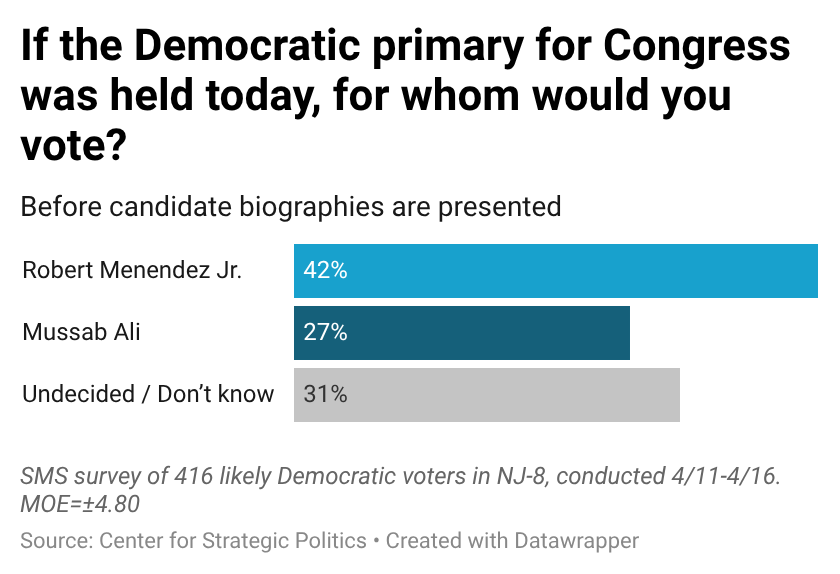
Rob Menendez maintains a strong lead when voters are asked who they would vote for if the election were held today. But Menendez is significantly below 50% of the vote, a weak position for an incumbent. Even though Menendez is extremely well-known with 94% name recognition, one-third of the electorate is undecided when presented a choice between him and a currently lower-profile challenger with only 68% name recognition.
When respondents are presented with short positive and negative biographies for both candidates, the situation changes dramatically. Once voters are informed about positive and negative arguments for both Menendez and Ali, Ali takes a significant lead over Menendez.
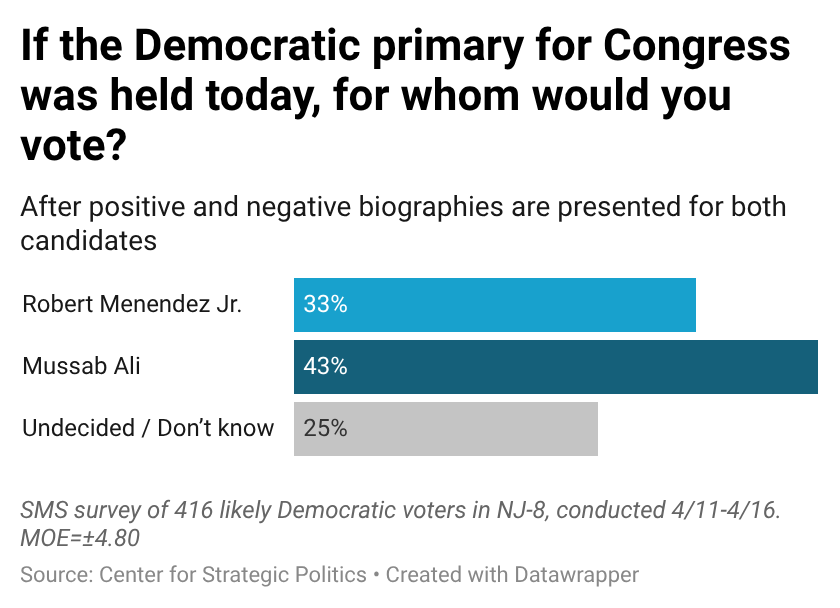
By separating the positive-only and full informed ballot questions, the flow of support between candidates becomes even clearer. After only positive biographies are presented, Mussab Ali gains significant support from undecided voters, while only a small percentage of Menendez voters are swayed. After negative biographies are added, a similar number of Menendez and Ali supporters shift to undecided. However, a slightly larger share of undecided voters shift to Ali, leaving him with a 10-point lead over Menendez.
Issues
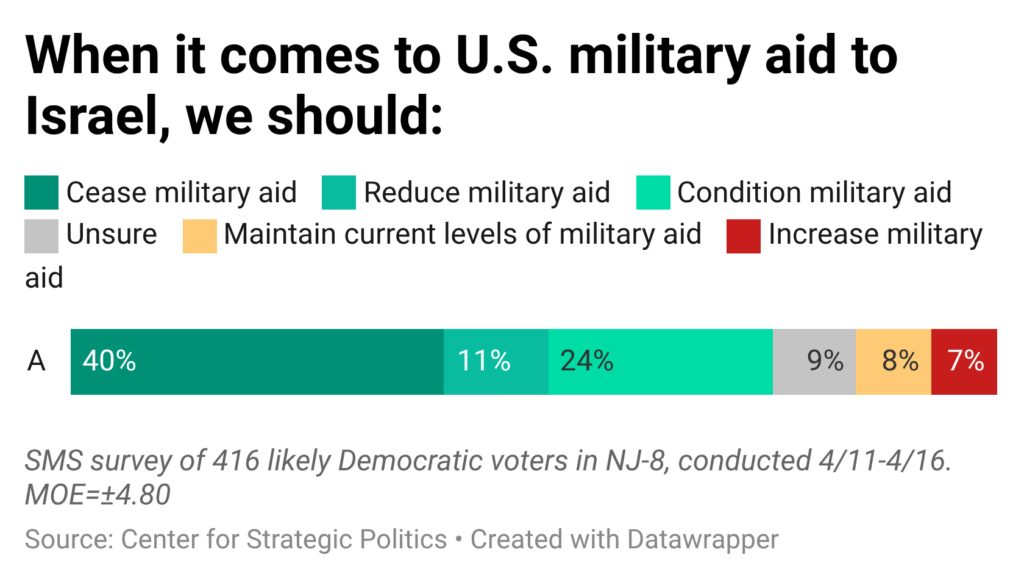
By a large margin, voters in NJ-8 oppose the status quo on U.S. military aid to Israel. 40% of respondents want to fully cease US military aid to Israel, while another 35% want to condition/reduce aid. When three-fourths of NJ-8 Democratic voters want to end or reduce military aid to Israel, Rob Menendez’s outdated stances leave him extremely vulnerable.
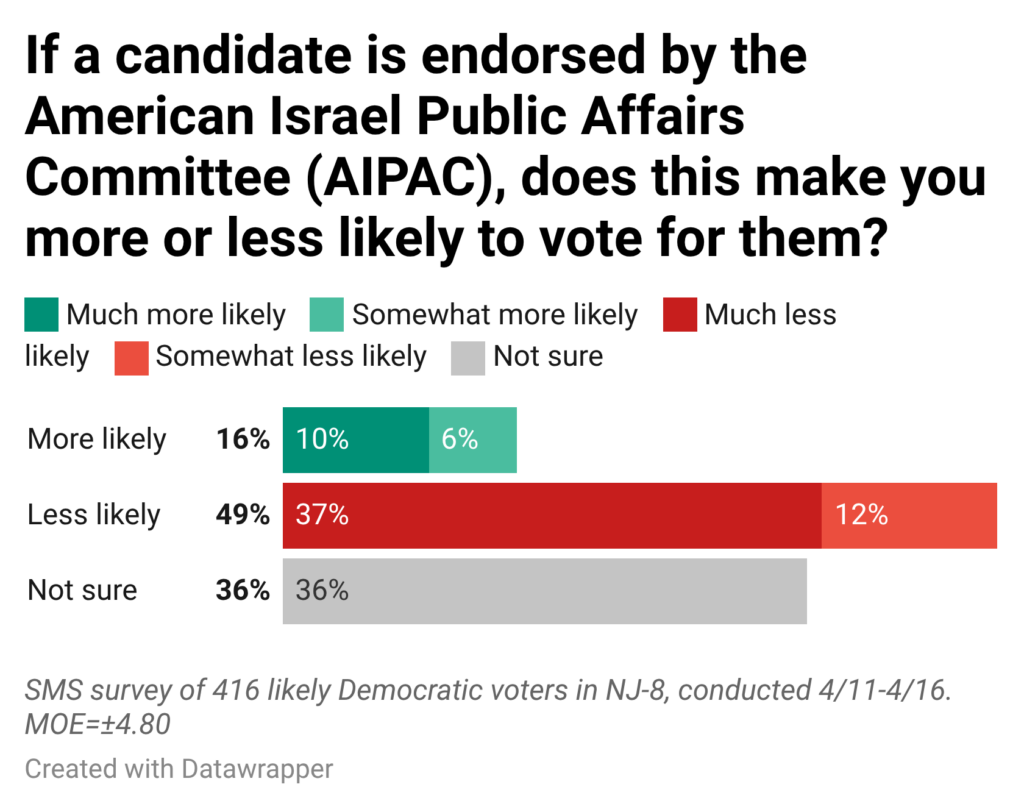
NJ-8 voters also strongly disapprove of AIPAC (the American Israel Public Affairs Committee), one of Menendez’s endorsing organizations. 49% of respondents say an AIPAC endorsement makes them less likely to vote for a candidate, while only 16% say it makes them more likely.
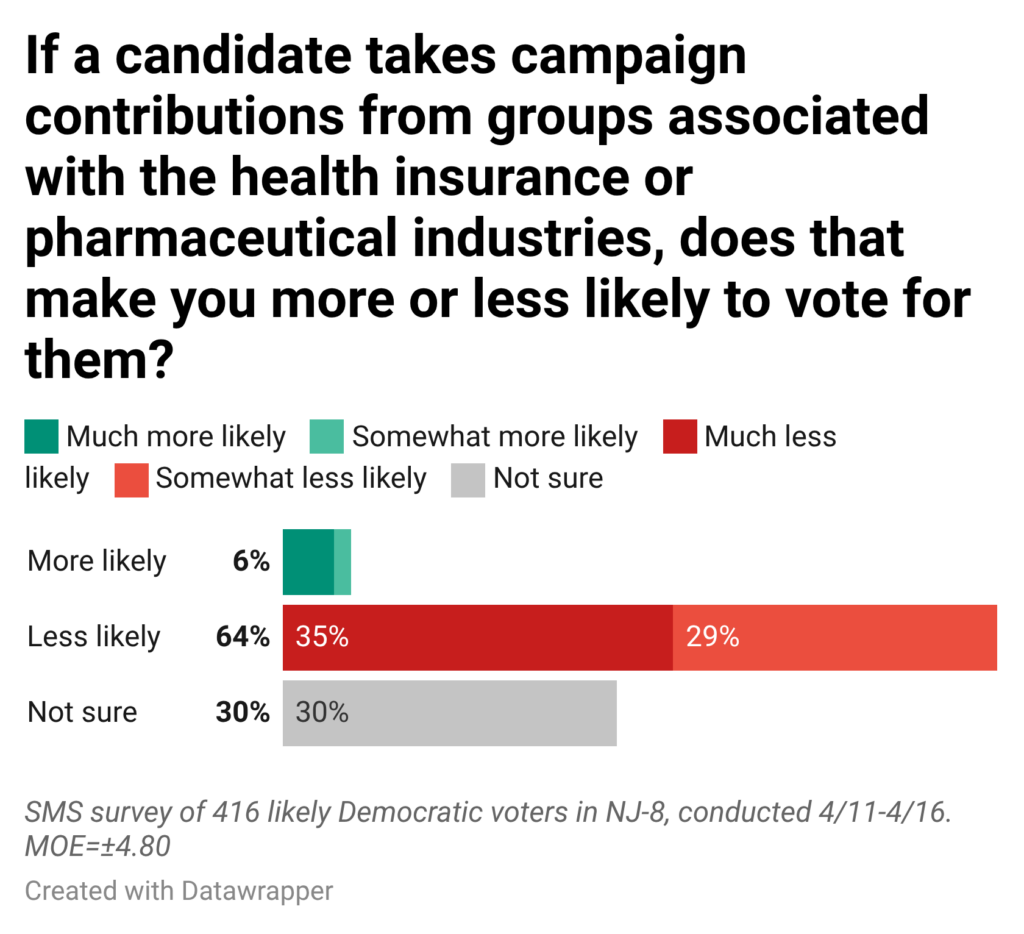
Even more polarizing than an endorsement from AIPAC are campaign contributions from the health insurance and pharmaceutical industries. Two-thirds of NJ-8 voters say they are less likely to vote for a candidate who takes these donations.
The full poll, including crosstabs, is available here.
The Center for Strategic Politics is where ideas shape the future of governance, analysis, and critical discourse.
For press inquiries, contact press@stratpolitics.org.
For all other questions, contact info@stratpolitics.org.