Between October 28th and October 30th, 2026, the Center for Strategic Politics conducted an English-language survey of 310 likely voters in Michigan’s 13th Congressional District using SMS to collect web responses. Where applicable, answer orders were shuffled when presented to respondents. Respondents outside the sampled population were screened by self-identification and voter file match. The sample was weighted to be representative of likely voters in MI-13 by age, race, gender, education, and primary turnout. The margin of error is ±5.57%. This survey was commissioned for the Democratic Socialists of America’s National Electoral Commission.
With only days until Election Day, Donavan McKinney is on track for an expected win in Michigan’s 13th Congressional District. But what might not be expected is how voters in this key Democratic base district feel about Israel, the war with Iran and the future of the Democratic Party. 66% support the Block the Bombs Act, 59% say Israel policy is a very important issue in deciding their vote, and a large majority want Congress to cut off funding for the war with Iran. Democrats also want new leadership in Congress, preferring every alternative offered to Chuck Schumer and Hakeem Jeffries, and believe replacing them will improve the electoral chances of Democratic candidates in 2028. New polling from the Center for Strategic Politics takes an in-depth look at what voters are thinking in MI-13 on Israel, Iran, and other issues.
Key Takeaways
Arming Israel is a losing position in MI-13
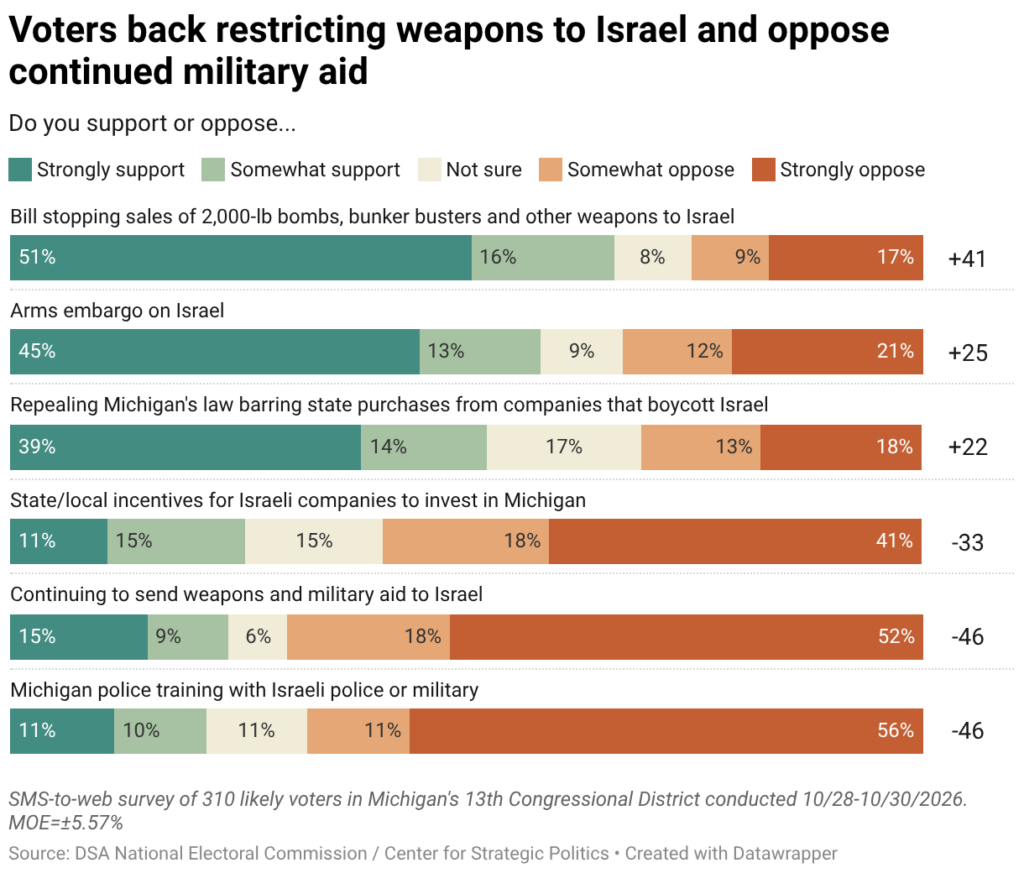
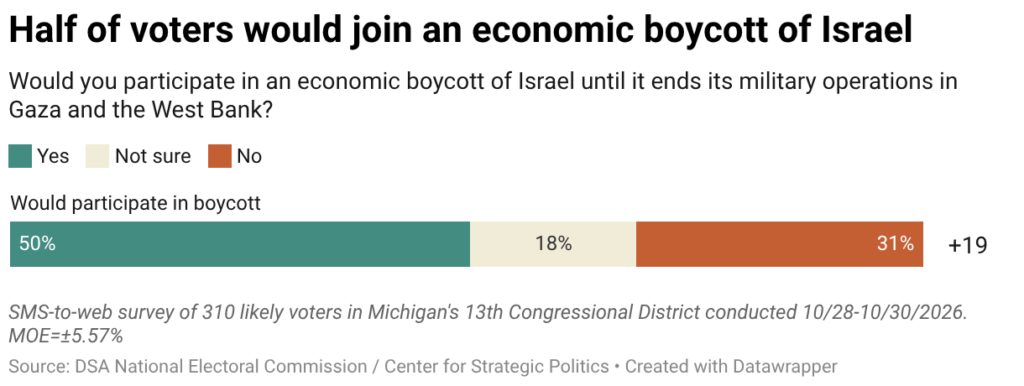
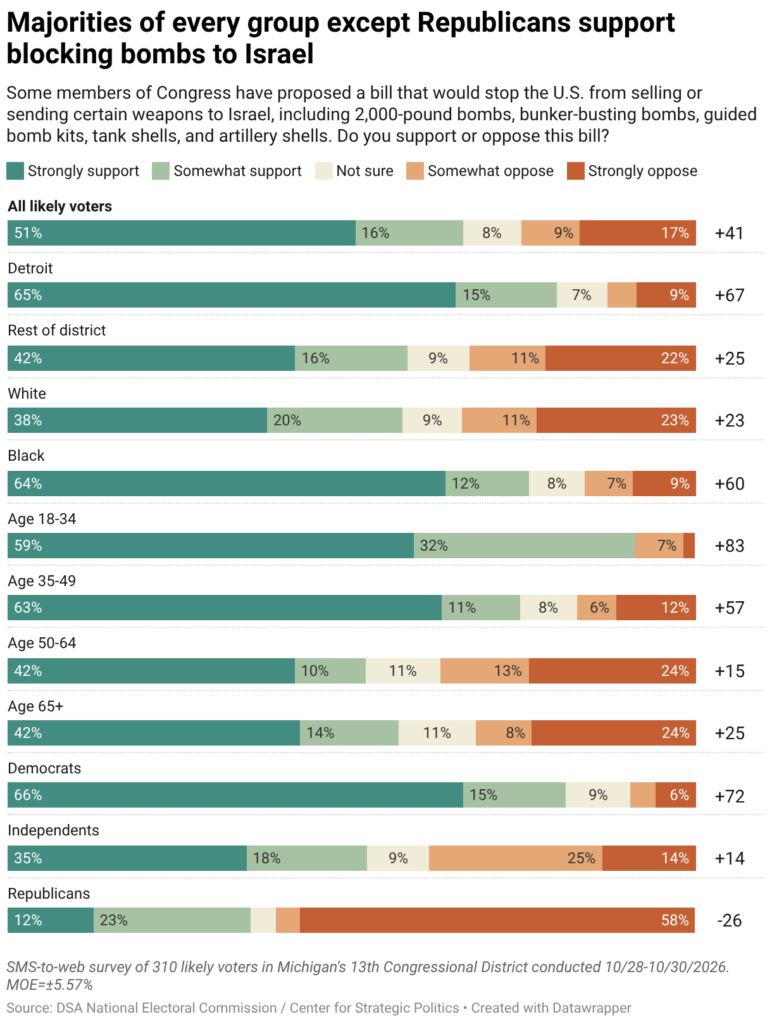
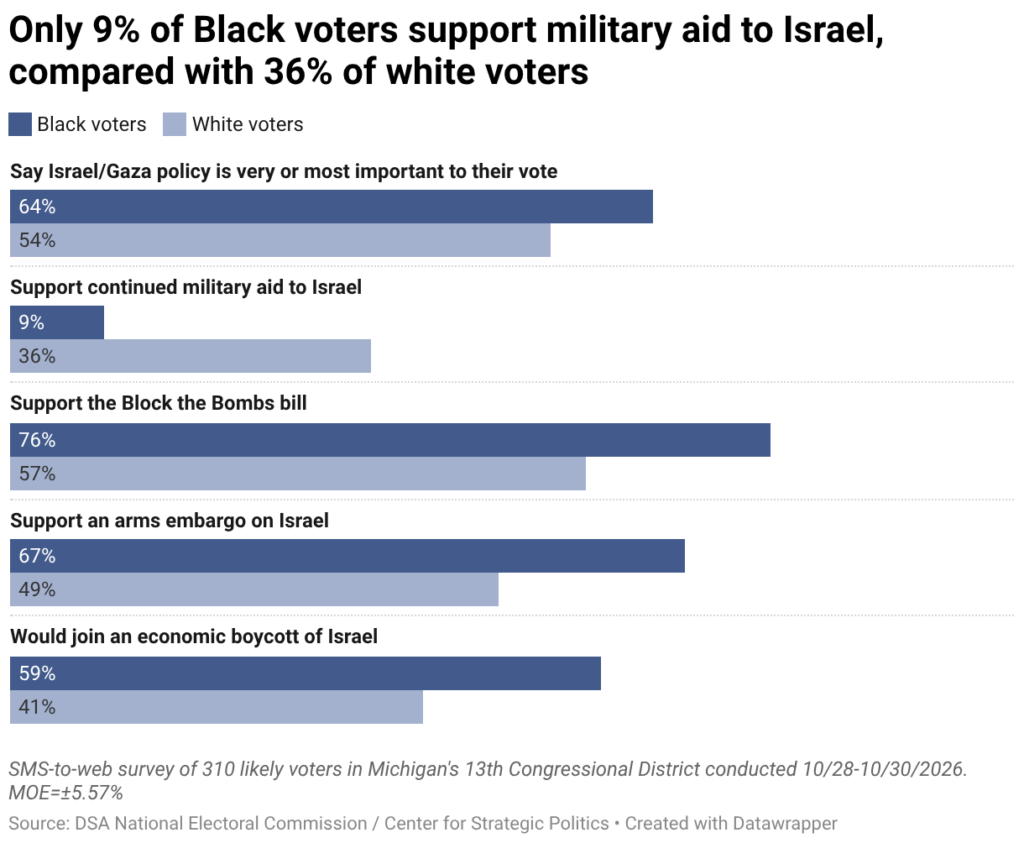
Continued U.S. military aid to Israel is deeply unpopular in the district. Seven in ten voters oppose sending more weapons, and two-thirds back the Block the Bombs bill, which would stop the U.S. from sending Israel 2,000-pound bombs, bunker busters and other heavy munitions. A majority would go further and support a full arms embargo, and half say they would personally join an economic boycott of Israel.
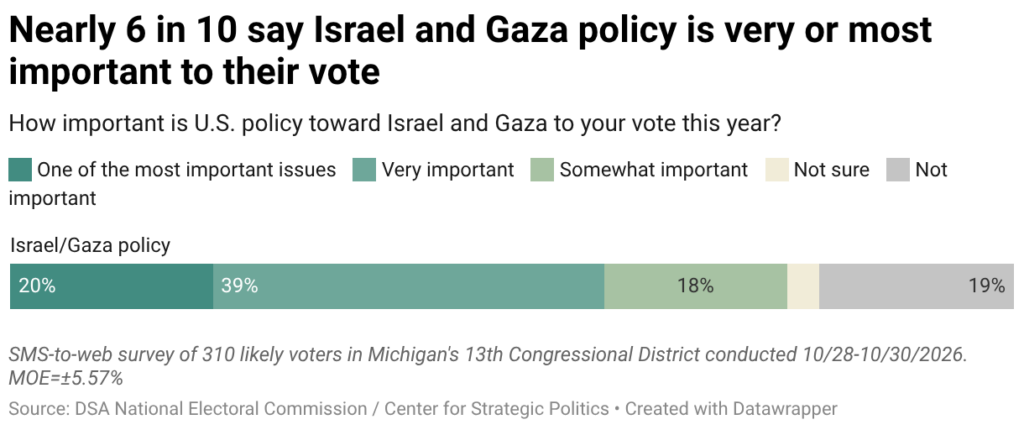
And this is not a niche issue: almost 60% of voters say Israel policy is one of their most important, or a very important, issue when deciding their vote. Black voters weigh this issue more heavily than white voters (64% vs. 54%), and it is the most important or a very important issue for 76% of 18–34 year olds in MI-13.
Opposition to Israel is widespread across all demographic groups polled, with the exception of Republicans.
AIPAC is toxic, and refusing its money is an asset
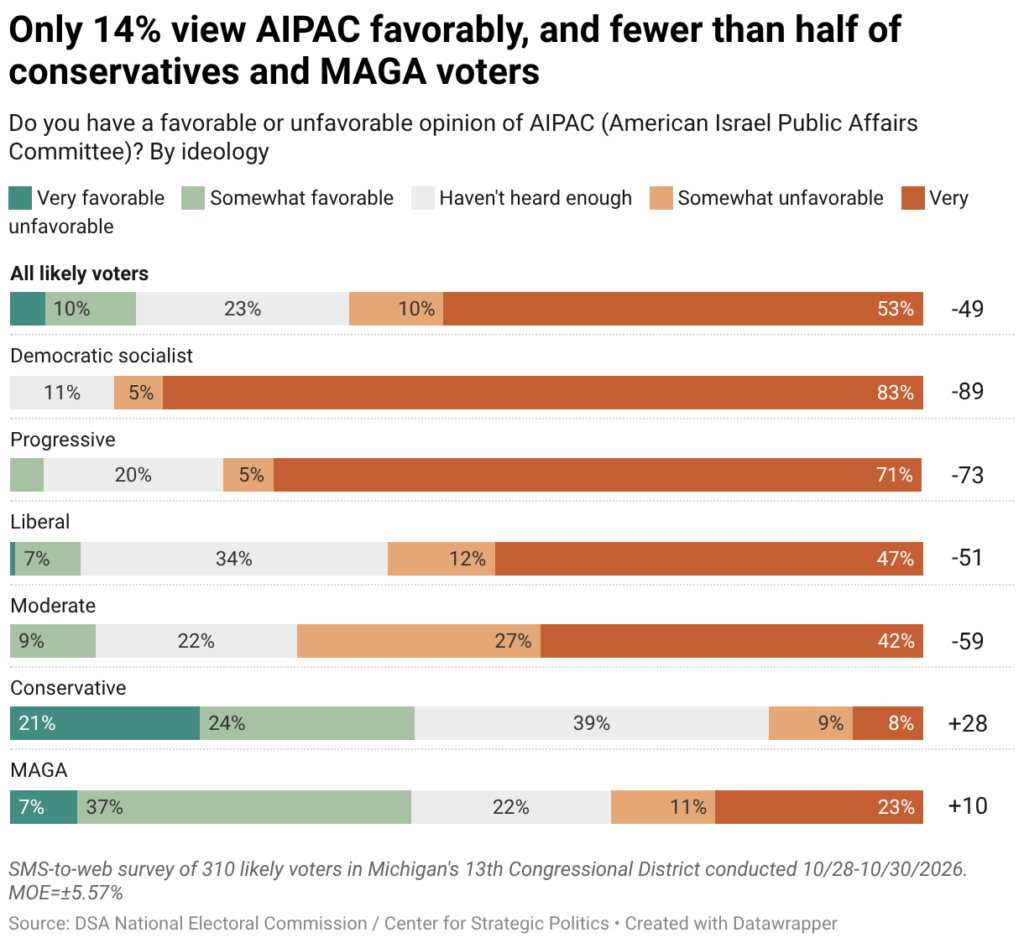
Only one in seven voters view AIPAC favorably, putting it alongside the Republican Party as the most-disliked organizations we polled. Even on the right, fewer than half of conservative and MAGA voters see AIPAC favorably. Interestingly, while conservative and MAGA voters have similar rates of AIPAC favorability, MAGA voters are over twice as likely to have an unfavorable view of AIPAC.
That makes AIPAC money a liability. 63% of voters are more likely to support a candidate who rejects money from AIPAC and its affiliates. In fact, rejecting AIPAC money is a net positive for Republicans (+4) and 2024 Trump voters (+12) as well.
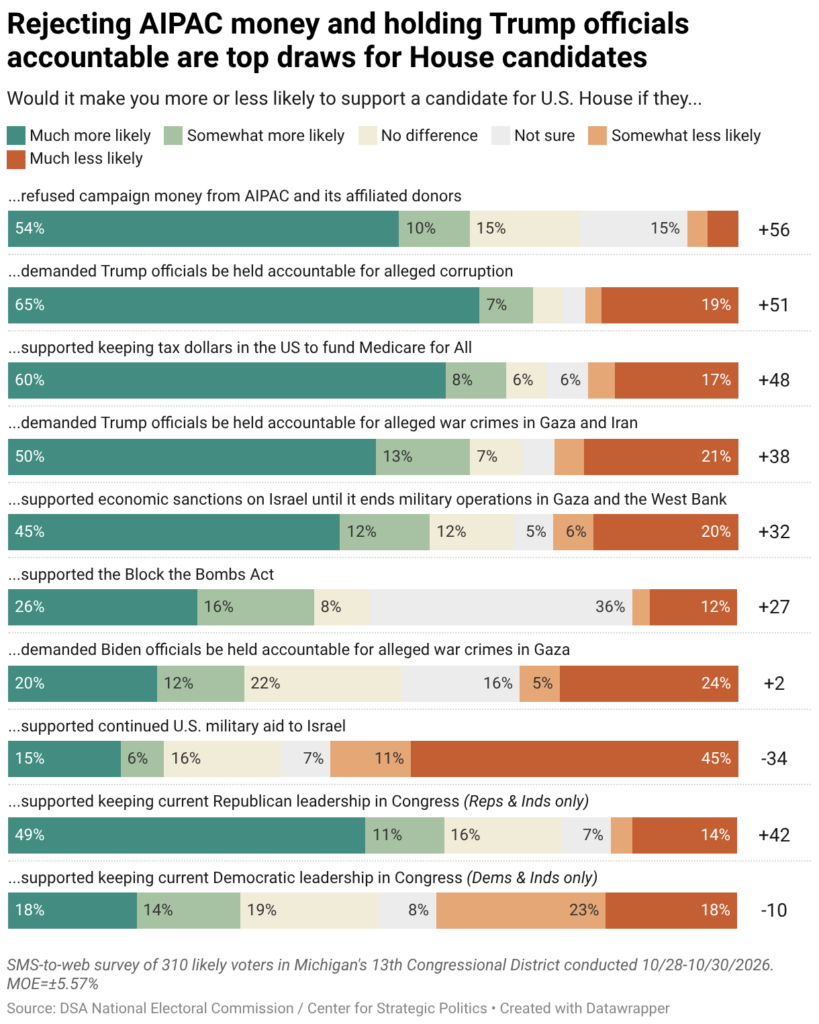
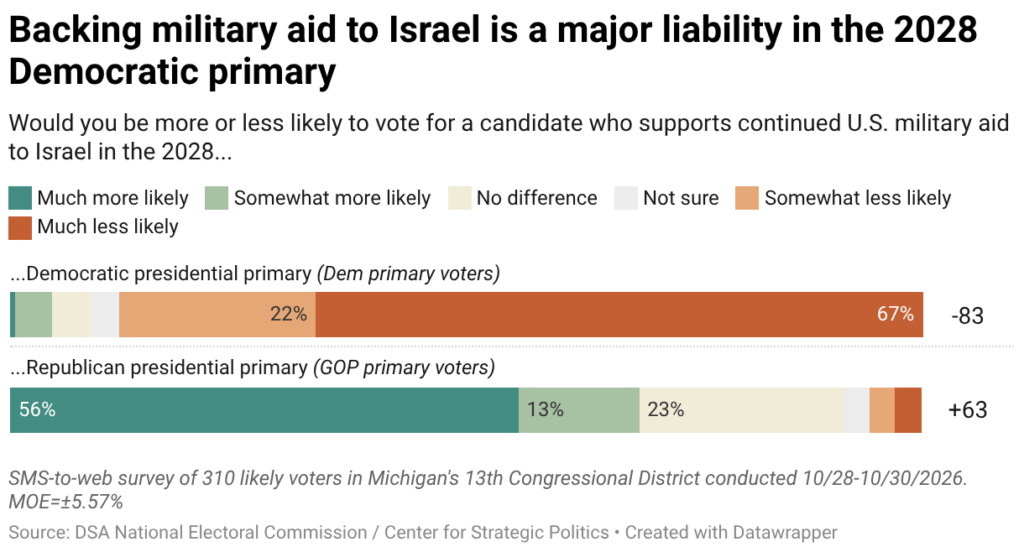
Looking ahead to 2028, nearly nine in ten likely Democratic primary voters say they’d be less likely to support a presidential candidate who backs continued military aid to Israel.
Voters see Iran as Trump’s war and want Congress to end it
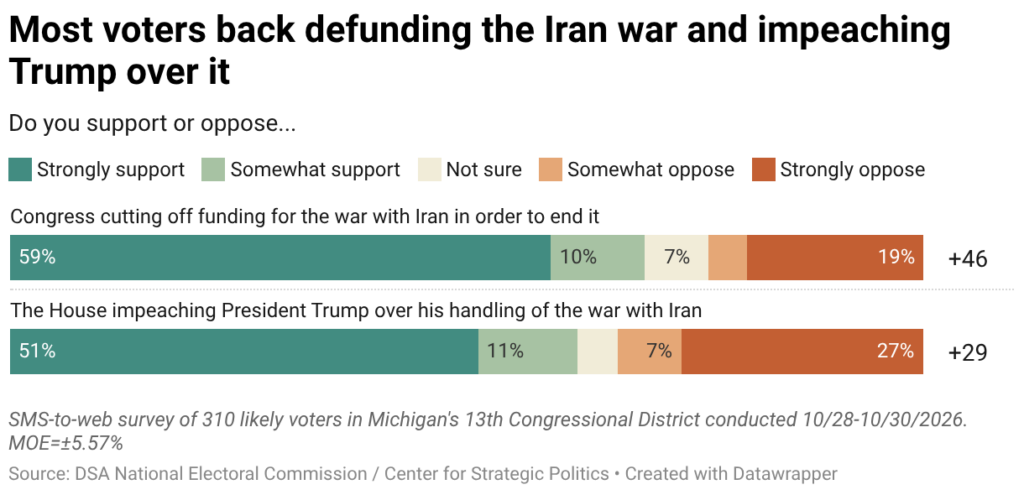
Seven in ten voters strongly disapprove of how Donald Trump is handling the conflict with Iran, and they want Congress to act: an equal proportion support cutting off all funding for the war, and a majority support impeaching Trump over his handling of it.
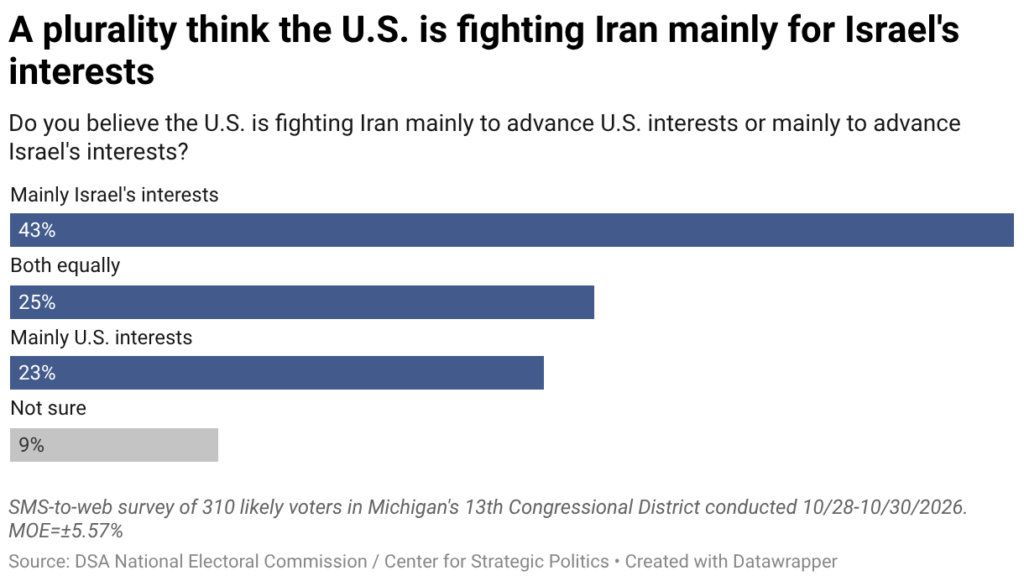
A plurality of voters also believe that the U.S. is fighting Iran mainly to advance Israel’s interests, while only 23% see the war as mainly advancing U.S. interests.
Democratic voters want new leaders in Congress
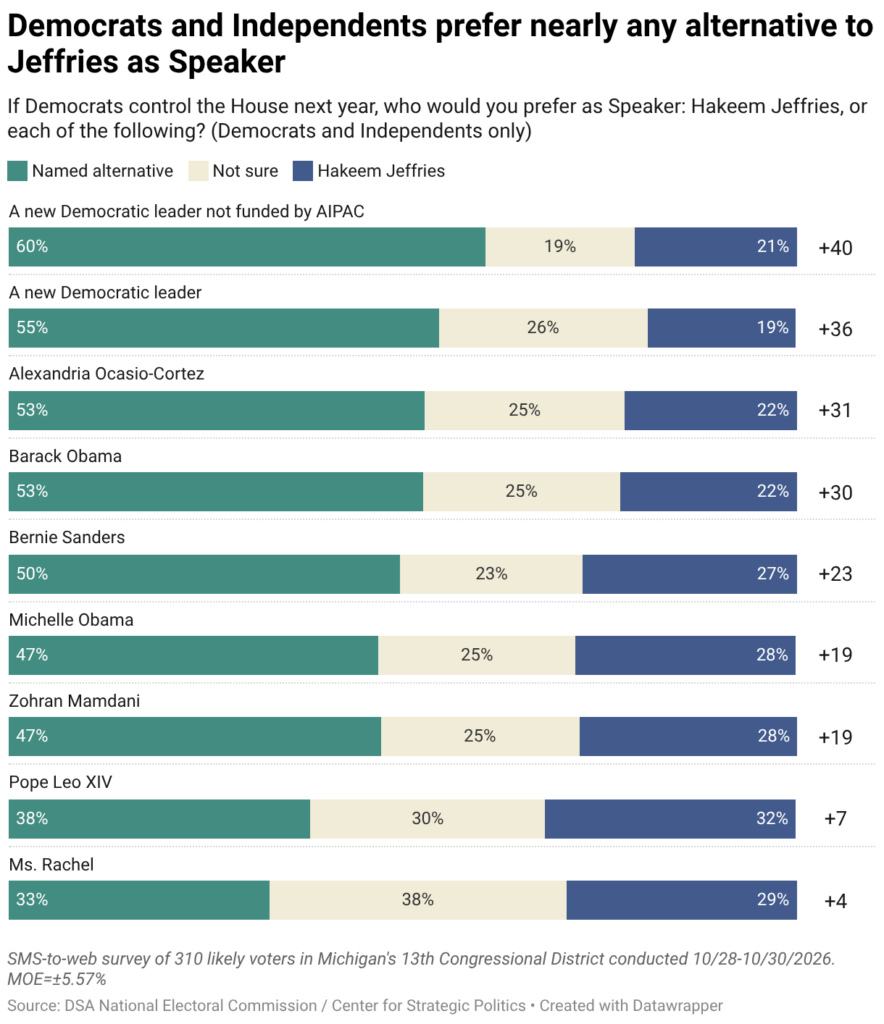
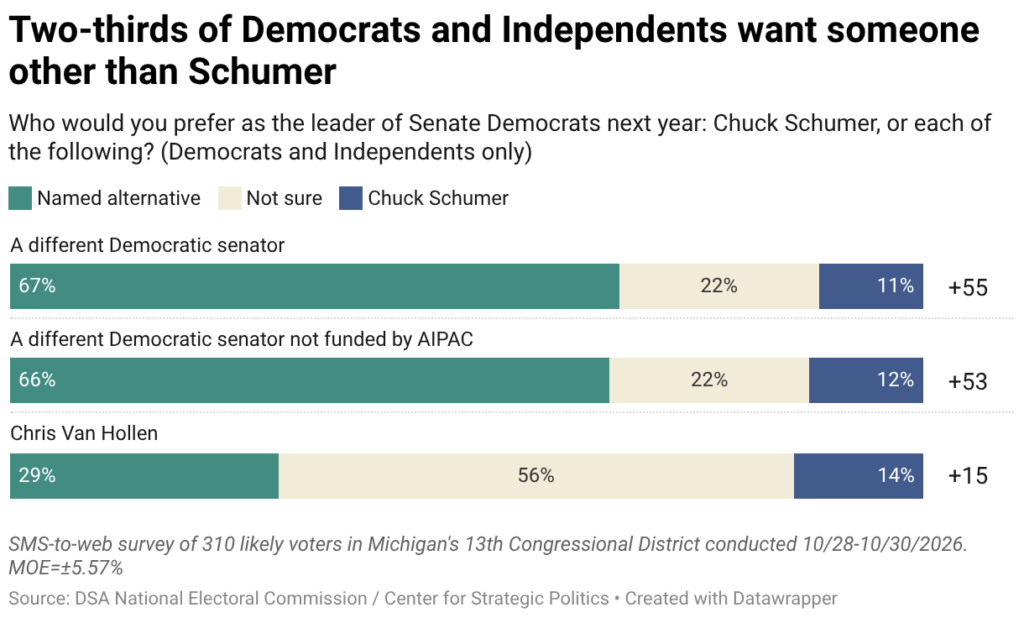
Democrats and Independents in MI-13 are ready to move on from their party’s leadership in Congress. Republican primary voters signaled support for their Congressional leadership, while Democratic primary voters signaled the opposite. Asked whether they’d prefer Hakeem Jeffries or someone else as Speaker, they chose every alternative proposed, from Alexandria Ocasio-Cortez and Barack Obama to a generic new leader. A new Democratic leader “not funded by AIPAC” beats Jeffries by nearly three to one. Chuck Schumer fares even worse, losing to a generic Democratic senator by 55 points.
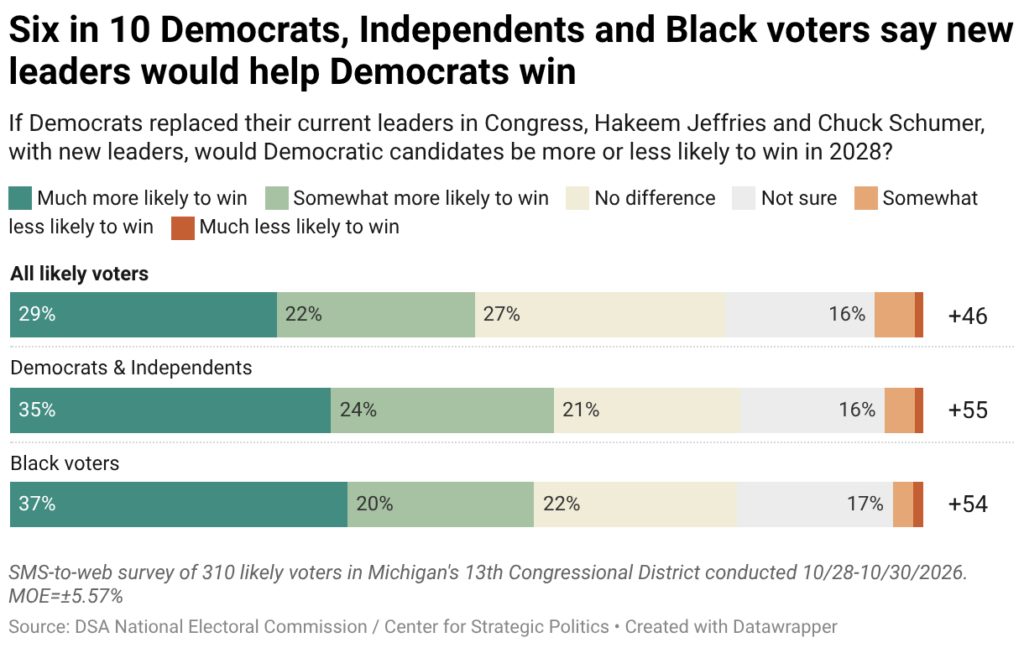
Voters also think new leadership would help Democrats win. A majority say the party would be more likely to win in 2028 with new leaders in Congress, with Black voters agreeing by an even higher margin.
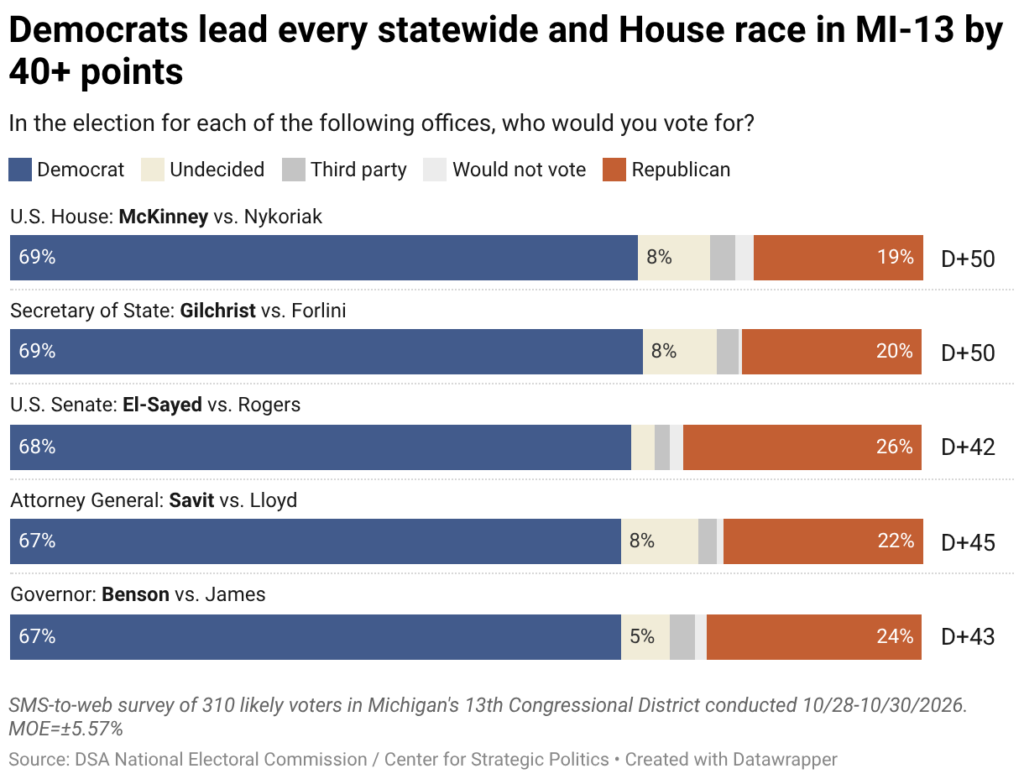
Democrats lead every race on the ballot with similar levels of support, but margins vary
All major Democratic candidates have similar levels of support in MI-13, ranging from 67% to 69%. Only 1% of Democratic voters intend to vote for the Republican Senate candidate Mike Rogers, while over 5% of Republican voters intend to vote for the Democratic Senate candidate Abdul El-Sayed.
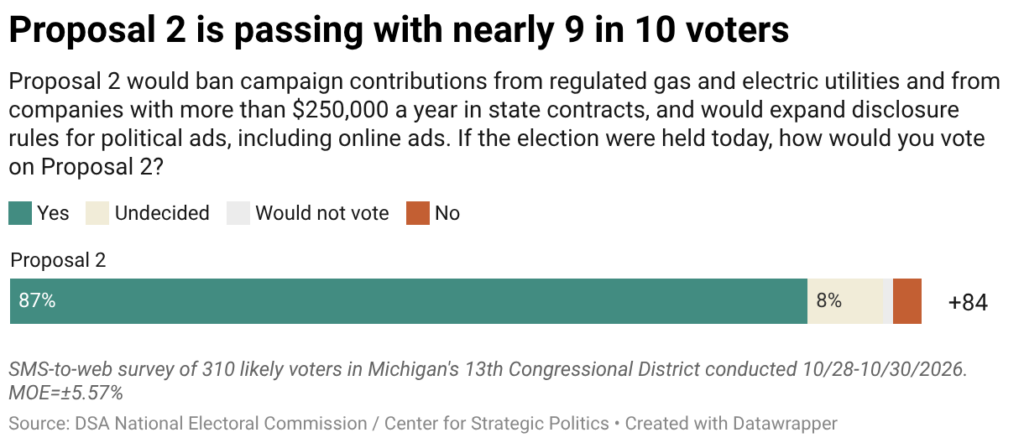
Further down the ballot, Proposal 2 is headed for a landslide in MI-13. The measure would ban political contributions from regulated gas and electric utilities and from companies with more than $250,000 a year in state contracts, and it would tighten disclosure rules for political ads. The proposal has wide bipartisan support, with 91% of Democrats and 71% of Republicans indicating they’ll vote in favor.
The full poll, including crosstabs, is available here.
The Center for Strategic Politics is where ideas shape the future of governance, analysis, and critical discourse.
For press inquiries, contact press@stratpolitics.org.
For all other questions, contact info@stratpolitics.org.